Lent 2019 – The Meaning of Discipleship Part 2

March 27, 2019

Matthew 5:13a, “You are the salt of the earth. But if salt loses its saltiness, how will it become salty again?”

Salt is a common item almost every household in the world has on a shelf. While researching salt and the verse for today, I discovered a wonderful website called “Salt Works” I have provided the link under references below. Here’s a sampling of the page, “As far back as 6050 BC, salt has been an important and integral part of the world’s history, as it has been interwoven into countless civilizations. Used as a part of Egyptian religious offerings and valuable trade between the Phoenicians and their Mediterranean empire, salt and history have been inextricably intertwined for millennia, with great importance placed on salt by many different cultures. Even today, the history of salt touches our daily lives. The word “salary” was derived from the word “salt.” Salt was highly valued and its production was legally restricted in ancient times, so it was historically used as a method of trade and currency. The word “salad” also originated from “salt,” and began with the early Romans salting their leafy greens and vegetables. Undeniably, the history of salt is both broad and unique, leaving its indelible mark in cultures across the globe.”

Author, Juan Huertas offers us a story about uses salt while cooking. He and his sister were preparing spaghetti for dinner, at different times during the cooking experience they both added salt to the dish knowing it was an important seasoning. Unfortunately, since they both added salt the final product ended up being too salty and being kids thought perhaps adding sugar could remedy the problem. You guessed it, it only added sweetness to the already too salty mix. Their mother suggested that only by adding more meat to the already salty dish could have helped it to be less salty. Salt is a wonderful addition to many dishes as it heightens the fullness of its flavor. But too much can ruin the entire dish.

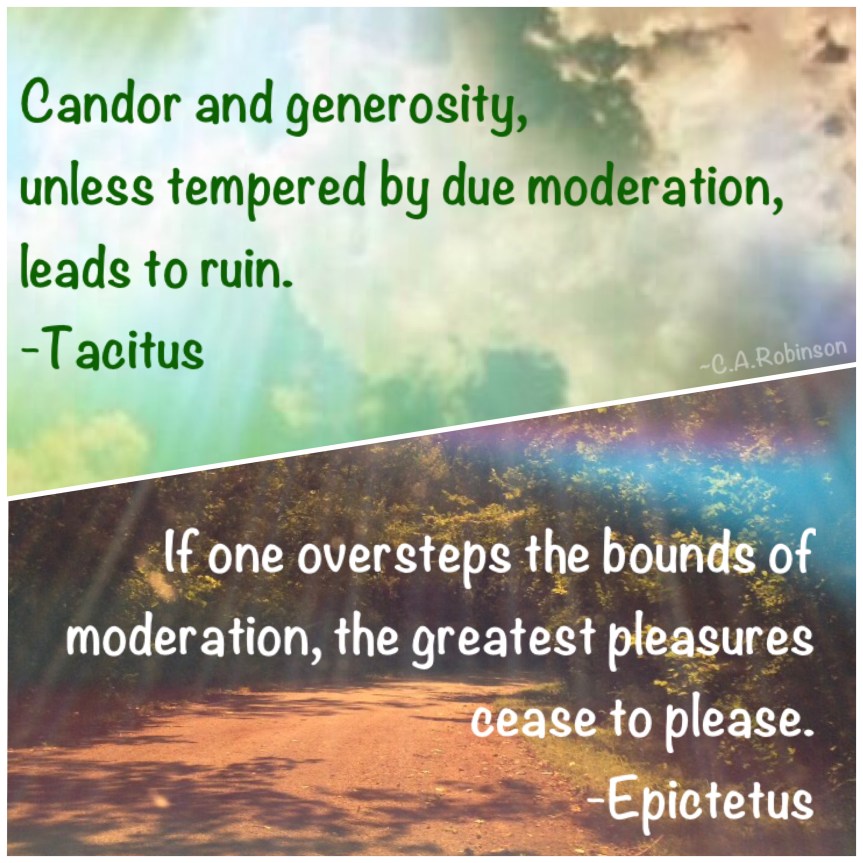
Moderation works best in most things.
As I was reading an article on https://www.christianity.com I discovered that there are differing opinions on Matthew 5:13, on the subject of salt:

• Some think that its whiteness represents the purity of the justified believer.

• Some say that salt’s flavoring properties imply that Christians are to add divine flavor to the world.

• Some believe that Christians are to sting the world with rebuke and judgment the way salt stings an open wound.

• Some assert that, as salt, Christians are to create a thirst for Christ.

However, the author of this article suggests that it stops decay, and that when Jesus said, “You are the salt of the earth”, He meant that all of His disciples were to serve as preservatives, stopping the moral decay in our sin infected world.

Salt was used during Jesus’ time as a way of preserving fish, they would pack fish with salt to keep it from rotting or spoiling, it would be kept safe to use when needed. The article states, “The spiritual health and strength of the Christian is to counteract the corruption that is in the world. Christians, as salt, are to inhibit sin’s power to destroy lives. This in turn creates opportunity for the gospel to be proclaimed and received.We have been given a wonderful privilege to be the salt of the earth, but Jesus gave us a warning. The second half of Matthew 5:13 states: “But if salt loses its taste, how would its saltiness be restored? It is no longer good for anything, except to be thrown out and trodden underfoot by men”. Jesus did not say that we can lose our salvation; He said that we can lose our saltiness. When salt is contaminated it becomes corrosive and poisonous. Contaminated salt cannot even be used for fertilizer on the field, so it has to be thrown on the road. If we have allowed disobedience, carelessness and indifference to rule our lives, we have become contaminated salt and have lost our saltiness. We need to confess our sin and let the Lord restore us to the purpose for which we were called.”
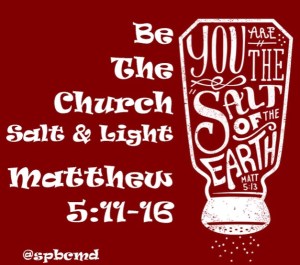
There’s a lot of information available on the subject of salt and lots of opinions and views on Jesus’ words in Matthew 5:13, I have read several articles today and I don’t disagree with any, and I believe Jesus is telling us to share the gospel with the world, our specific neighborhoods, where we live, work and play. We can season/add salt to the lives around us through our actions and our words, sometimes with a “pinch” of salt and other times with a “heaping” or “rounded” helping handful of salt. As Christians, we need to listen and be led by the Holy Spirit when witnessing to others and be careful not to season too heavily with “salt” being mindful of who we are representing. We are disciples!

Friends, I hope you are able to glean exactly what you need from this post especially given the large amount of information I shared. I’m a blessed and excited to be on this Lenten journey with you. Your support and prayers are felt and deeply appreciated. Thank you, blessings and peace be with you today and always~

Breath Prayer: Way-making Lord,…remove my distractions.

~Peace~

References:

https://www.biblegateway.com/

https://www.seasalt.com/history-of-salt

https://www.biblegateway.com/resources/matthew-henry/Matt.5.13-Matt.5.16

https://www.christianity.com/bible/christian-you-are-salt-and-light-11596480.html

Additional Videos you might be interested in viewing:
 

Lent 2019 – The Meaning of Discipleship Part 2

March 26, 2019

Matthew 5:11-12a, “Happy are you when people insult you and harass you and speak all kinds of bad and false things about you, all because of me. Be full of joy and be glad, because you have a great reward in heaven.”

These verses remind me of something Jesus says later in chapter five, in verse 38-42 called: Law of retaliation

“You have heard that it was said, An eye for an eye and a tooth for a tooth But I say to you that you must not oppose those who want to hurt you. If people slap you on your right cheek, you must turn the left cheek to them as well. When they wish to haul you to court and take your shirt, let them have your coat too. When they force you to go one mile, go with them two. Give to those who ask, and don’t refuse those who wish to borrow from you.” ~ Matthew 5:38-42

I have to say these instructions are difficult to hear. No one likes to be insulted or harassed and then to make it worse we are to let it happen plus turn the other cheek? Honestly, I struggle with this, I personally get very defensive when I feel attacked, or whenever someone else I care about is being attacked. I’m not really much of a fighter, my feelings get hurt easily and I cry relatively easy as well, BUT I can also get mad rather quickly. My voice gets loud and I start talking very quickly, I say things I wish I had said sooner, before they festered and grew under my skin. I think the biggest obstacle is “pride” our own self-preservation of pride. It gets in the way of growth and maturity especially when it comes to interpersonal relationships. The “my opinion/belief” is right and yours is wrong, not allowing for differing opinions to coexist. When I think about all the lives that have been lost due to the inability to listen to others, to consider options, to agree to disagree and to choose life and love over hate and brutality it saddens my heart. Many people have died for their faith, for social justice and individual rights to name only a few. People so committed to their cause it cost them everything, everything except the most important, their soul. As believers, no one can take your soul because it is safe with our God.

Our author, Juan Huertas tells us about Óscar Romero in the reading for today. He was a Roman Catholicism Archbishop of El Salvador in the late 1970’s, who was assassinated for speaking out on behalf of the poor. Others that came to mind while reading were Martin Luther King and Gandhi. I was reading some additional stories online and I found a fascinating article I was unaware of and what to share it with you. Many may know it already but just in case you don’t I listed the website below. It is from the bbc, UK Martyrs of the Modern Era, published July 9, 1998. Ten 20th century Christian martyrs have been commemorated with statues at Westminster Abbey in London. The statues were unveiled before the Queen and the Duke of Edinburgh at Westminster Abbey.

• In 1918, the Grand Duchess Elizabeth of Russia was killed by the Bolsheviks.

• Manche Masemola was a Anglican catechumen from South Africa who was killed in 1928 by her parents at the age of 16.

• Maximilian Kolbe was canonised by the Roman Catholic Church after being killed by the Nazis in 1941.

• In 1941, Lucian Tapiede, an Anglican from Papua New Guinea, was killed during the Japanese invasion.

• Dietrich Bonhoeffer was a Lutheran pastor and theologian. killed by the Nazis in 1945.

• Esther John, a Presbyterian evangelist from Pakistan, was allegedly killed by a Muslim fanatic in 1960.

• One of the world’s most famous civil rights activists, Martin Luther King, a baptist, was assassinated in 1969.

• In 1972, Wang Zhiming was killed during the Chinese cultural revolution. He was a pastor and evangelist.

• In 1977, Janani Luwum was assassinated during the rule of Idi Amin, in Uganda, for being an Anglican Archbishop.

• Oscar Romero was a Roman Catholic Archbishop in El Salvado, assassinated in 1980.

When people do what Jesus would do, when we do what Jesus would do, we are living our discipleship and it will not be popular and might cause trouble. Jesus never promised that the life of discipleship would be easy but it is worth it. We may not see the fruition of the seeds we plant but the cultivating we do is laying the groundwork and a firm foundation for the future.

A favorite verse of mine is 1 Corinthians 13:12, “For now we see through a glass, darkly; but then face to face: now I know in part; but then shall I know even as also I am known.”

Juan Huertas closes with words of encouragement to us, “Hold on tight. Lean on the love of God. Continue to do what Jesus does. Do not be discouraged, the world needs to know the salvation of our God.”

I want to say, “Keep up the good fight, Love like Jesus.” The world needs you, you were born with a purpose and a plan!

Jeremiah 29:11, “For I know the plans I have for you,” declares the Lord, “plans to prosper you and not to harm you, plans to give you hope and a future.”

Isaiah 14:24, “The Lord Almighty has sworn, “Surely, as I have planned, so it will be, and as I have purposed, so it will happen.”

Breath Prayer: O God, give me courage…to love like you.

~Peace~

References:

https://www.biblegateway.com/

http://news.bbc.co.uk/2/hi/uk/129587.s

Lent 2019 – The Meaning of Discipleship Part 2

Matthew 5:10, “Happy are people whose lives are harassed because they are righteous, because the kingdom of heaven is theirs.” (CEB)

Greetings to you all~

I hope everyone had a restful and soulful Sunday. I had an amazing worship experience with my family and friends at church. It is truly a blessing to be free to worship God, Free from harassment or persecution. Not all believers have this luxury. In many parts of the world it can be quite dangerous to share the love of God and Jesus Christ. Loving and professing Jesus Christ as Lord and Savior can lead to trouble, should that deter us from doing what is right, what is just? During this Lenten journey we have talked about doing what Jesus did, to love deeply and welcome broadly. Asking ourselves the question, “What would Jesus do?” WWJD. Jesus loved loudly, he loved the unwelcome, the despised, the diseased, the afflicted, the sinner…the marginal and the left behind. This is exactly who we are called to minister to, just as Jesus did. I’m reminded of Jesus telling of his mission to the Pharisees after He had spent time with Levi, the tax collector, “Jesus answered them, “It is not the healthy who need a doctor, but the sick. I have not come to call the righteous, but sinners to repentance.” ~Luke 5:31-32.

Let’s rejoice in following Jesus’ example and to not become complacent in the luxury of life, to pray for those who are harassed for their faith. And to ask ourselves the hard questions, “Am I welcoming enough? Am I accepting enough? Am I loving enough?” This season is an opportunity to more fully connect with God and if needed recalibrate ourselves to serve like Jesus. May God’s blessing rain upon you as you live like Jesus.

Breath Prayer: Surprising Lord, …help me be like you!

~Peace~

References:

http://www.biblegateway.com/

https://biblehub.com/matthew/5-10.htm

Lent 2019 – The Meaning of Discipleship Part 2

Third Sunday in Lent, March 24, 2019

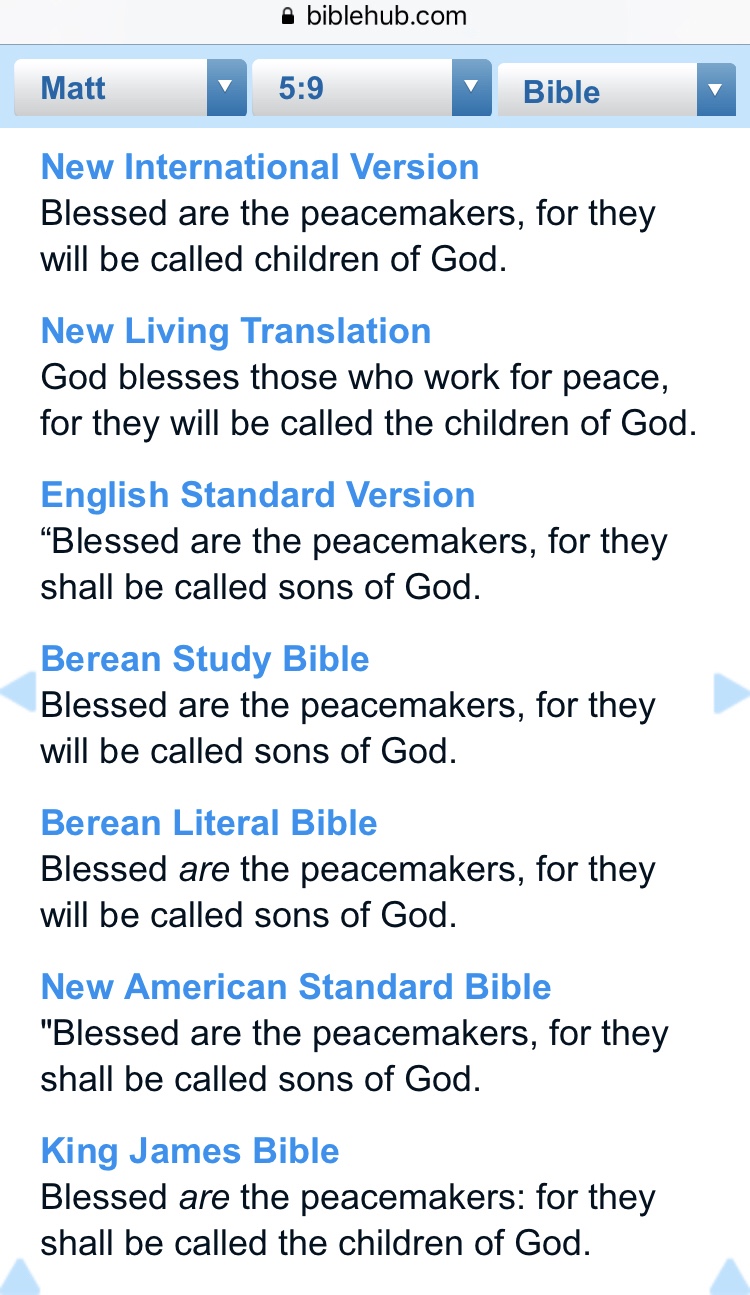
Matthew 5:9, “Happy are people who make peace, because they will be call God’s children.”

Depending on which translation of the Bible you use the word “peace” is also used referred to as “peacemakers”. Below are examples for you and I’ve included a reference at the bottom of this page.

Peace:

• a state of tranquility or quiet

freedom from civil disturbance

a state of security or order within a community provided for by law or custom

freedom from disquieting or oppressive thoughts or emotions

harmony in personal relations

a state or period of mutual concord between governments

• a pact or agreement to end hostilities between those who have been at war or in a stateof enmity

• used interjectionally to ask for silence for silence; calm; or as a greeting or farewell

Peacemaker:

• one who makes peace especially by reconciling parties at variance

In the biblical dictionary peace is described as, “The Meaning of Peace.” In English, the word “peace” conjures up a passive picture, one showing an absence of civil disturbance or hostilities, or a personality free from internal and external strife. The biblical concept of peace is larger than that and rests heavily on the Hebrew root slm, which means “to be complete” or “to be sound.”

The biblical dictionary states that “Peacemaker” occurs only in the plural in (Matthew 5:9, “Blessed are the peacemakers (eirenopoioi): for they shall be called sons of God” (who is “the God of peace”)). We have also what seems to be a reflection of this saying in James 3:18, “The fruit of righteousness is sown in peace for (the Revised Version margin “by”) them that make peace” (tois poiousin eirenen). In classical Greek a “peacemaker” was an ambassador sent to treat of peace. The word in Matthew 5:9 would, perhaps, be better rendered “peace-workers,” implying not merely making peace between those who are at variance, but working peace as that which is the will of the God of peace for men.

Just a few weeks ago I was talking with a friend about being a “peacekeeper/peacemaker” and at the time I said that such a person does not necessarily need to be quiet, calm and tranquil. Those are often attributed to peace but sometimes to keep the peace one must raise their voice above the noise of the crowd or the situation in order to be heard. Peace often comes after a storm has passed. Harmonious relationships sometimes start out or at least go through some battles that cause considerable noise/fighting. Two of my favorite movies remind me of individuals I would call peacemakers. The first is, “Gandhi” he fought for India’s independence with nonviolent civil disobedience that was not always peaceful. And my second favorite, “The Inn of the Sixth Happiness” it is the true story of Gladys Aylward (Ingrid Bergman), a British maid, who believes that she is destined to go to China. She is rejected as a missionary, but she eventually finds her way to the town of Yang Cheng. Her peaceful existence, however, is interrupted by Japan’s invasion of China. Aided by Lin Nan (Curt Jurgens), a half-Chinese/half-Dutch military officer, Gladys must lead a group of orphans to safety by embarking on a dangerous mountain journey. I find both of these stories truly fascinating and their courage infectious. If you have never seen either of these movies I highly recommend them.

If you grew up in a large household you probably can think of someone who was known as the “peacemaker” or the “peacekeeper” that one person who tried extremely hard to keep everyone happy and content, all at the same time. That’s a tall order to try to fill, in fact it is impossible because one person is not capable of making everyone happy, all at the same time. This is where compromise comes into place and a peacemaker can be beneficial. I actually experienced a situation just a couple of days ago where I walked in on a heated conversation with some coworkers and my first instinct was to not get involved or at the very least lose my temper and say something I might regret. I listened intently for what seemed like a long while, maybe 5-8 minutes, oh and by the way, I stayed in the room/office because the conversation related to me as well. Motivated by not wanting to regret saying something in anger or at the very least disrespectful, I tried keeping the peace by staying quiet. Then I ask myself the question, “What ways if any do I want to help make or reach peace in this particular situation?” I impulsively opened my mouth and words and phases starting spewing out of my mouth, like a broken water pipe. I was not rude, or cursing or being disrespectful but I was getting a lot of things out that should have been said a long time ago. I was asked to stop yelling at one point in the conversation, *I tend to get louder when I’m excited/passionate about something. I apologized immediately and stated I didn’t mean to sound like I was yelling and I lowered my voice and continued articulating my points in the conversation. This situation lasted about 2 hours and had been going for an hour before I opted in. I am happy to report that by the end of this situation/conversation everyone felt as if they had been given the opportunity to speak and be heard, procedures and practices currently in place were questioned and alternatives were suggested, frustrations that have been pinned up for years were released as if a dam had been breached and flood waters raged over dry dust plains that had been long forgotten. It was not a peaceful conversation but in my humble opinion each person was acting and serving as a peacemaker for the sake of everyone involved. I wish I could report that things have all been resolved; however, they are still pending at the moment but I have faith things will change nonetheless.

The writer of the Lenten Devotional I’m using, Juan Huertas stated the following, “…to follow Jesus, to be a disciple, means to be a peacemaker. Peacemaking does not require a lack of conflict. Conflict is part of life; it means that we have opinions, varied stories and different passions. Conflict means that there is something at stake, that there have been some misunderstanding and a disconnect.” I just love that! Don’t you?

Friends, let’s work together around the world to be “Peacemakers” not for the sake of ourselves but for humanity everywhere because the kingdom of God is at hand and we are called into Discipleship. ~Peace Be With You~

Breath Prayer: “Lord, make me…an instrument of your peace.” *attributed to Francis of Assisi

~Peace~

References:

https://biblehub.com/matthew/5-9.htm

https://www.biblegateway.com/

https://www.biblestudytools.com/dictionary/peace/

https://www.franciscanmedia.org/saint-francis-of-assisi/

https://www.google.com/amp/s/www.biography.com/.amp/people/mahatma-gandhi-9305898

https://davidalton.net/2013/05/11/gladys-aylward-the-little-woman-and-chinas-inn-of-the-sixth-happiness/

Lent 2019 – The Meaning of Discipleship

Matthew 5:8, “Happy are people who have pure hearts, because they will see God.” (CEB)

As I read today’s message, I found myself trying to define “pure heart.” Without looking up the definition or googling it, my answer is someone who it true, truthful, honest, sees only good in others and in the world.

Pure:

free from harshness

• free from roughness

• being in tune

containing nothing that does not properly belong

• unmixed with other matter

• free from taint

• free from what weakens

Throughout our lives we all have been ask similar questions such as these:

• What are you living for?

• What do you most desire?

Depending upon the context of these questions being ask our answers could be different in a broad scope. Let’s narrow our scope, which sounds entirely wrong to me from a Christian perspective. Our broad answers would include things such as our jobs, our education, job positions, our relationships to list a few. In regards to what I suggested as a more narrow view is our spiritual life, our eternal life…simply stated “Our Life!” What are you living for? As a believer in Jesus Christ, my answer must be Jesus! The One who created me, the One who loves me. What do you desire most? As a follower of Jesus Christ, I desire to live the life I was created for, seek to do God’s Will.

I read an article prior to writing this blog post written by Imanuel Christian titled, “12. Blessed Are The Pure in Heart (Matthew 5:8)” From The Series: Studies In The Gospel of Matthew. This is a quote from the article, ““Blessed are the pure in heart, for they shall see God” (Matthew 5:8). That’s it! That’s the goal of the Christian life! That’s what we are living for – that we may live our life in such a way that we see God. If we see God, that will open up the treasure trove of all the blessings, not only for eternity, but also for life here and now. And the key to open that treasure trove is a pure heart!” WOW! Isn’t that true!

The article goes on and includes fascinating truths about the Beatitudes, “This is the most central and the most significant of all the beatitudes mentioned in this fifth chapter of Matthew. You cannot be poor in spirit without having a pure heart. You cannot mourn for the things that displease God without having a pure heart. You cannot be meek, you cannot hunger and thirst for righteousness, you cannot be merciful, you cannot be a peacemaker or be prepared to stand persecution for the name of Christ without having a pure heart. Actually, this is one of the most central principles of the Christian life that we see in the whole Bible. The heart of the matter is the matter of the heart.”

“THE HEART OF THE MATTER IS THE MATTER OF THE HEART!”

We are human and sinful but we do not have to live sinful lives. We can seek God, search for God, abide in God, pray to God, ask God for forgiveness. We are always welcome in God’s house, God’s heart. Jeremiah 29:13, “You will see me and find me when you seek me with all your heart.

The more I read about the beatitudes the more clearly I am understanding its relevance to discipleship and growing in my relationship with God. I hope the same is true for you. Blessing to you today! Thanks for traveling with me on this beautiful journey!

I found this song and it says everything I wanted to share in this post, I hope you like it as much as I do, I think it’s absolutely beautiful.

~Peace~

Breath Prayer: O God, create in me … a clean heart.

References:

https://www.biblegateway.com/

https://bible.org/seriespage/blessed-are-pure-heart-matthew-58

https://www.merriam-webster.com/dictionary/pure?src=search-dict-box

https://billygraham.org/decision-magazine/july-august-2009/gods-desire-for-his-children/

Lent 2019 – The Meaning of Discipleship

Matthew 5:7, “Happy are people who show mercy, because they will receive mercy.”

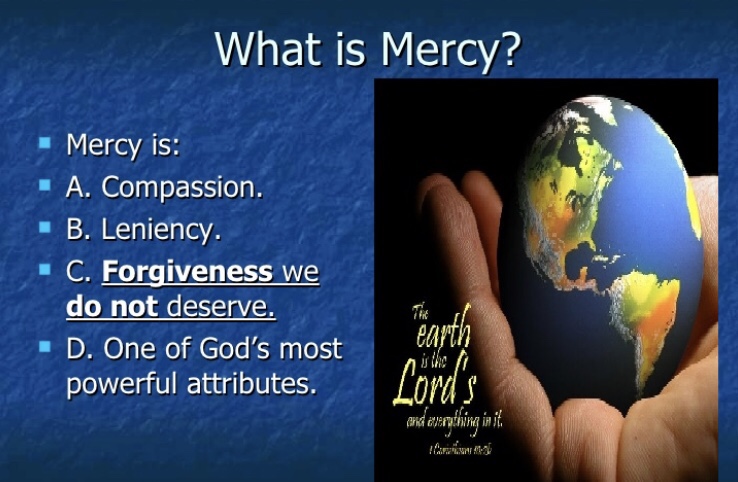
As we face a new day together, we are given with another attribute from God, presented by Jesus in his “Sermon on the Mount” and verse 7 is one of eight blessings recounted in Matthew chapter five called, “The Beatitudes.” We, as believers are being asked to doing as Jesus did, and today that thing is “mercy” specially give mercy. Have you experienced mercy in your life? Chances are you have and I’m sure it was a huge relief when it happened. Have you ever been pulled over by a police office for a traffic violation and he or she only gave you a written warning or better yet a verbal warning? What a sigh of relief when those words were spoken! A ticket and a fine could have just as easily been handed out but mercy was shown and mercy for whatever reason, is mercy nonetheless. Have you ever heard or seen a court proceeding and the defendant requests “mercy” from the court?

Did you know that according to the simplified bible dictionary the word “mercy” appears 273 times in the KJV of the Bible. And, according to the Institute of Creation Research, the word appears some 341 times in the Bible and four Hebrew and three Greek words associated with mercy appear a total of 454 times and are also translated as “kindness,” “loving-kindness,” “goodness,” “favor,” “compassion,” and “pity.” Of the sixty-six books of the Bible, only sixteen do not use one of these words for mercy. This raw data tells me that mercy is important and God wants us to understand it and model in our relationships.

Doing as Jesus did is not an easy task to do nor is it even achievable given that Jesus was sinless and human, while also being divine. This fact should never deter us from trying or from modeling our behavior after his. Often we have people in our lives that we look up to and maybe even want to be like all the while knowing we can never truly be exactly like them but we still try, right? I remember as a kid, putting my mom or dads shoes on, although they were too big, I pretended to be them. I wanted to be like them. I would wear my dads coat or my moms jewelry, just to be like them. In many ways, we can do the same with Jesus…we can practice using kind words, being patient with others, sharing with those who have nothing, noticing the forgotten and marginal, speak truth and pray, to mention a few.

Today, let’s practice mercy. Mercy requires empathy, which is the ability to see ourselves in others. With mercy we must also have compassion, awareness and humility. Sometimes it can be truly difficult to see ourselves in the same situations as others, imagining making the same mistakes but we do. When we look beyond our own reflection in the mirror and allow our imperfections to ooze into the reflection from the edges, that we keep at bay through the beveled edges we created…our true image emerges. And then, doing as Jesus would do, you see the real true you…a child of God, in the image of God and loved, so very loved!

Each day as we continue this journey, we are growing and changing, we are refining ourselves and learning more about our personal discipleship and becoming more Christlike, thank you for traveling with me.

Micah 6:8, “ He has told you, O man, what is good; and what does the Lord require of you but to do justice, and to love kindness, and to walk humbly with your God?”

Breath Prayer: Merciful God,…help me see mercy.

~Peace~

References:

http://www.christianshepherd.org/simplified_bible_dictionary/m/mercy.pdf

https://www.biblegateway.com

https://www.icr.org/article/gods-everlasting-mercy

Lent 2019 – The Meaning of Discipleship

Matthew 5:6, “Happy are people who are hungry and thirsty for righteousness, because they will be fed until they are full.”

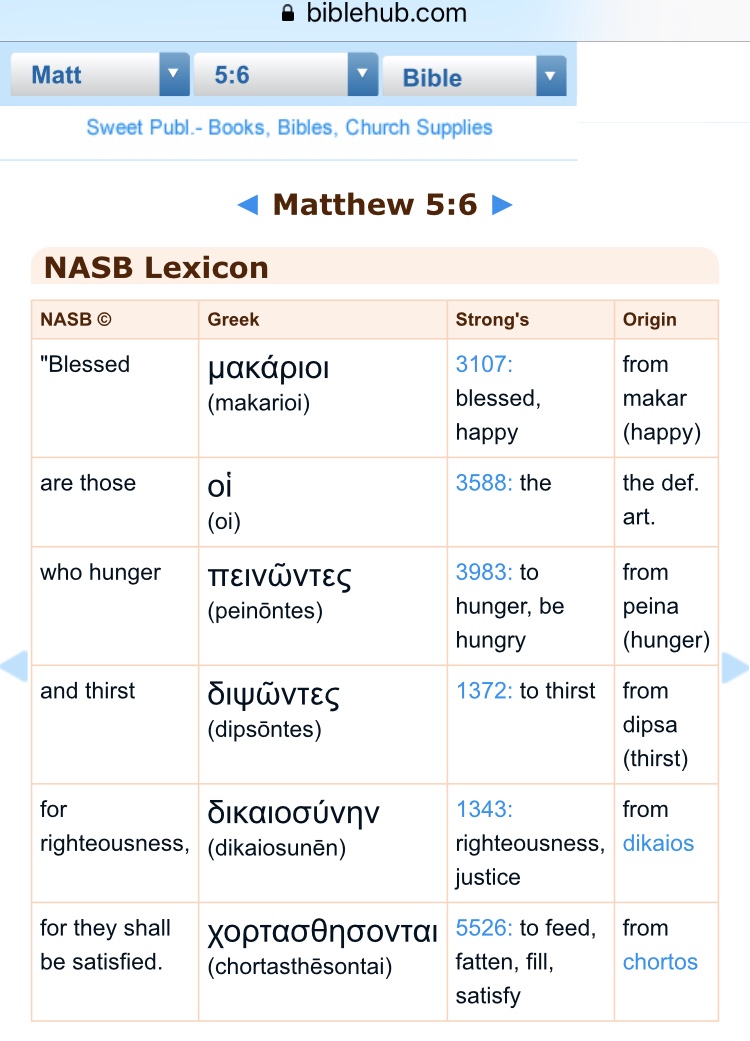
The writer of “Sanctuary for Lent” Juan Huertas, stated that the Spanish translation of the New Testament, the Greek word dikaiosuné is translated as “justice,” whereas English translators render it as “righteousness.” An English translation of the Spanish translation would then read, “Happy are people who are hungry and thirsty for justice, because they will be fed until full.”

That translation tells us that doing justice is doing what God does. So, in today’s verse we are being told that we will be glad, blessed, happy if we are hungry and thirsty for doing what God does. Being a being a disciple means that we do what God does.

Disciple:

  • A disciple is simply someone who believes in Jesus and seeks to follow him in his or her daily life. Originally, of course, a disciple was someone who literally knew Jesus in the flesh and followed him — but after he was taken up into heaven, anyone who was committed to Jesus was called a disciple. *excerpt from Kansas City Star May 25, 2016 by Rev. Billy Graham.

As disciples of God, we hunger and thirst for righteousness, not for food that merely sustains the body. We are called to seek soulful and constant meals of righteousness, grace to do the work of every day in its day, as duly as the living body calls for food. Hunger is a desire for food to sustain, as sanctifying righteousness feeds the soul. Thirst is the desire of drink to refresh, as justifying righteousness quenches the parched-ness of the soul. In order for us to be ready to receive grace from God to fill our souls, we much recognize that we must sense our own emptiness so that God can, and not just fill us with his desires but to satiate our souls so we can do what God desires and have our souls filled to overflowing with God’s righteousness and his favor.

As we continue to more fully understand our discipleship on this Lenten journey, may your soul be fed beyond all consumption and your thirst extinguished with all the knowledge of justice, being enriched with grace and righteousness for God’s eternal glory.

It is truly a blessing to share this space with you and I’m grateful for your support and prayers. May you be blessed today and may others be blessed through you. You are beloved, You are a blessing, You are a child of God, You are LOVED!

~Peace~

Breath Prayer: For justice Lord,…help me hunger.

Breath Prayer: Lord, develop in me…a gospel palate

References:

https://www.biblegateway.com

https://biblehub.com/lexicon/matthew/5-6.htm

https://www.kansascity.com/living/liv-columns-blogs/billy-graham/article77272832.html

https://www.biblegateway.com/resources/matthew-henry/Matt.5.3-Matt.5.12

Lent 2019 – The Meaning of Discipleship 03/20/2019

Matthew 5:5, “Happy are people who are humble, because they will inherit the earth.”

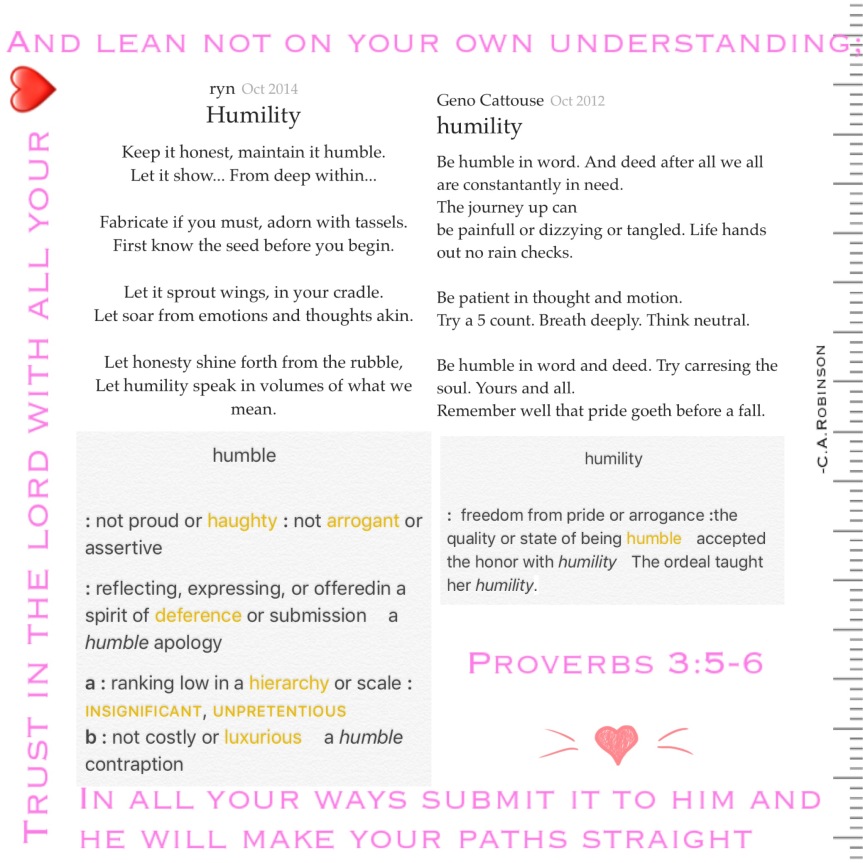
Juan Huertas, the writer of the “Sanctuary for Lent” pamphlet that I am reading and using as a guide for my blog throughout Lent is calling attention to the word, humility today. He shares that humility for him is being rooted, about reality and recognition that he is human.

What about you? What is humility to you?

I posted a blog entry in June 2018 and I shared some of my thoughts about the subject of humility. In that post I describe my best friend and the best adjective I have to describe her is “humble”, she has taught me more about humility through her character than I could ever have learned from a book. She’s a blessing! She encourages me through actions and thought-provoking questions. She doesn’t provide answers to my questions, she encourages me to search. She is truthful, trustworthy and honest, she is patient, kind and thoughtful. She is intentional in all her actions and her words. She is respectful and sincere. She would caution me to tell you that she is human and makes mistakes just like everyone else, she is not perfect. After all, we are all human! Her anchor verse is Proverbs 3:5-6 and she has a thirst for knowledge; giving and receiving it. We are all human and children of God!

1C2E4F5B-87A8-42F5-A2F8-A5F1FE25B080

Humility comes from the Latin word humilis, which literally mean low.

Humility is someone who spends his life taking care of others. low.

Humility is the quality of being humble.

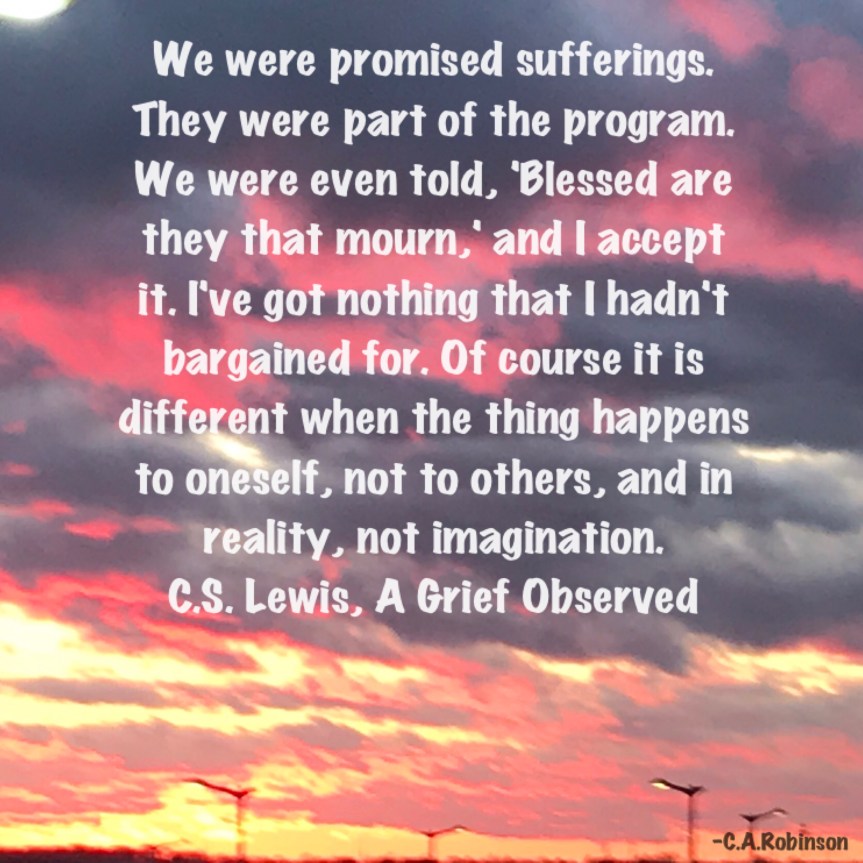
Humility for many people is a key virtue and a cornerstone to the foundation of the Christian life. Our world and many cultures coerce us into the false belief that we are self-made that leads us to develop self-centeredness, egotistical attitudes and vulgar conceit. All of this culminating to the delusion that we are in control of our own destinies. Genuine humility recognizes that we are created beings, we have responsibilities and that our actions have consequences. This season of Lent reminds us that life consists of humility, community and difficulties. Just as we read yesterday, grief and loss are part of the life experience. C. S. Lewis reminded us that God was upfront and honest about in his book, “A Grief Observed,” stating, “We were promised sufferings. They were part of the program. We were even told, ‘Blessed are they that mourn,’ and I accept it. I’ve got nothing that I hadn’t bargained for.”

Matthew 5:4, “Blessed are those who mourn, for they will be comforted.”

As we continue on our Lenten journey I encourage you to embrace “Christlikeness” and embody “Humility.”

God alone creates out of nothingness. All good things comes from the Father, and our fellowship with one another, not things offers life abundant.

I found this song by Rend Collective and it touched my heart like a prayer, I hope you find it comforting and encouraging today.

Breath Prayer: Loving God,…keep me rooted.

~Peace~

References:

The Sanctuary For Lent by Juan Huertas and Abingdon Press https://www.abingdonpress.com/catalog/search?term=The+Sanctuary+for+Lent

https://charlotteannrobinson.com/2018/06/16/best-friend/

https://www.vocabulary.com/dictionary/humility

https://www.biblegateway.com

Lent 2019 – The Meaning of Discipleship

Matthew 5:4, “Happy are people who grieve, because they will be made glad.”

Just yesterday while walking into work with a friend I made the comment that the weather had finally improved. We discussed the finer points that though improved it could be better. Isn’t that true with most things? We find contentment but rarely feel completely satisfied. And, on other occasions when we recognize, as my friend and I did yesterday…the weather could always be worse. We had sunshine, blue skies filled with big fluffy white clouds! I have many things to be thankful for and God has blessed me in more ways than I can count. As I look around my community, at my job, my church, my state, my country and the world I see that there’s so many people hurting and grieving, saddened by what I see. Sometimes I am even angered but not knowing where that anger should be directed. Not everyone’s situation is the same, and I’m reminded (often) I am not to judge, I am called to love.

Matthew 22:36-40, “Teacher, which is the greatest commandment in the Law?” ‘Jesus replied: “‘Love the Lord your God with all your heart and with all your soul and with all your mind.’ This is the first and greatest commandment.  And the second is like it: ‘Love your neighbor as yourself.‘ All the Law and the Prophets hang on these two commandments.”

I’m not here to preach to you or even to cast a shadow on anyone’s behaviors, I am simply stating what God calls us to do, I am a sinner and I judge others and I’ve said things that I regret and I ask God for his forgiveness, I am thankful for his grace and redemption. Not because I’m worthy, I certainly am not but because God created me and he loves me, he forgives me.  I do not always understand the plans he has for me but I know to “Trust the Plan!*Quote borrowed from a dear friend who has taught me many things most importantly a genuine spirit of love, grace and humility.

Life has its share of disappointments and even devastating moments. We all experience loss in many ways and no two people will experience grief in the exact same way but we can try to support one another as we would want to be supported. Praying for others is very powerful! Supporting others and helping others can be accomplished in so many ways, do not discount even the smallest of gestures when done out of love and in the spirit of God. I love the slogan being used in many communities “Just be Kind!” Isn’t that just beautiful! It takes less time and energy to be kind verses being mad or angry, and usually fewer words. Simply saying “thank you” and ” you’re welcome” these can change someone’s entire outlook on life. A simply smile or comment, “Hi, how are you?” Could be the difference in someone’s life when they might be considering suicide … we never know what another person might be going through and that’s ok, I don’t think we are meant to but we can certainly make things worse by not considering our own words and actions. We are to be Jesus to others, to be his hands and feet in the world.

1 John4:17, “And as we live in God, our love grows more perfect. So we will not be afraid on the day of judgment, but we can face him with confidence because we live like Jesus here in this world.” (NLT)

I have on occasion felt the Holy Spirit directing me to “pay-it-forward” while in a drive-thru lane or at a convenient or grocery store, even at a stoplight when a person is asking for money. When we do these things we must do so freely of any expectation of the gift, trust God and let go. Gifts/blessing given with strings attached are in fact not gifts or blessings. Our gift of grace from God was freely given, and we must give as the “Giver” gave to us. Spread joy and share joy, when someone grieves, grieve with them and tell them that “joy comes in the morning” it may not be the next morning but the morning is coming and God will be there every step of the ways.

Psalm 30:5b, “Weeping may last through the night, but joy comes with the morning.

Breath Prayer: Amazing grace! … Joy come in the morning.

~Peace~

References:

https://biblehub.com/1_john/4-17.htm

https://biblehub.com/gnt/matthew/5.htm

https://www.biblegateway.com/passage/?search=Matthew+22%3A36-40&version=NIV

https://www.goodreads.com/work/quotes/894384-a-grief-observed

Lent 2019 – The Meaning of Discipleship

Matthew 5:3, “Happy are people who are hopeless, because the kingdom of heaven is theirs.” (CEB)

Happy in hopelessness?  Another bible version says, “Blessed are the poor in spirit?” (NIV)

I found a good reference article that explains this better than I could hope to and wanted to share it with you.  It is from Billy Graham, The question was posed, “What does it mean to be poor in spirit, as Jesus said we ought to be?

Billy Graham’s response:

“I don’t understand this, because it seems to me that we ought to strive to be rich in spirit, not poor. Or am I missing the point?  The answer, “Your confusion is understandable; after all, the Bible does warn us against being empty and impoverished in our souls, and urges us to seek spiritual riches instead. Jesus said, “For where your treasure is, there your heart will be also” (Matthew 6:21).

But Jesus also said that there is another kind of spiritual poverty—one we should seek. He said, “Blessed are the poor in spirit, for theirs is the kingdom of heaven” (Matthew 5:3). What did He mean? Simply this: We must be humble in our spirits. If you put the word “humble” in place of the word “poor,” you will understand what He meant.

In other words, when we come to God, we must realize our own sin and our spiritual emptiness and poverty. We must not be self-satisfied or proud in our hearts, thinking we don’t really need God. If we are, God cannot bless us. The Bible says, “God opposes the proud but gives grace to the humble” (James 4:6).

Pride can take all kinds of forms, but the worst is spiritual pride. Often the richer we are in things, the poorer we are in our hearts. Have you faced your own need of Christ? Do you realize that you are a sinner and need God’s forgiveness? Don’t let pride or anything else get in the way, but turn to Christ in humility and faith—and He will bless you and save you.”

It can be so easy to fall pry and to become overwhelmed by the world’s hopelessness, along with all the crimes, senseless deaths, cruelness and hatred. It is precisely within these things we are called to slow down, look around at our surroundings and find community in midst of hopelessness. Perhaps we can begin to see things that others are missing such as hopeful imagination emerging from within others as well as ourselves, we will begin to feel the seedlings of our faith taking root while nurturing the seedlings of others as we see them begin to grow. Then, before long we will recognize we are not alone and our community is growing. We will say, Immanuel (Hebrew: עִמָּנוּאֵל meaning, “God with us as we greet one another.

May your Lenten journey open your heart, mind and soul to the wonders of God’s calling in your life as you discover the meaning of discipleship for you.

Thanks you all for traveling with me on this Lenten journey. ~šālôm

Breath Prayer: God of hope, let the kingdom…be down in me!

~Peace~

References:

https://www.blueletterbible.org/Comm/smith_chuck/SermonNotes_Mat/Mat_16.cfm

https://billygraham.org/answer/what-does-it-mean-to-be-poor-in-spirit-as-jesus-said-we-ought-to-be/

https://en.m.wikipedia.org/wiki/Matthew_5:3

https://www.biblestudytools.com/ceb/matthew/passage/?q=matthew+5:3-12